August 17, 2009
Where I live there is a unique set of topographical characteristics that resulted in an example of “people’s capacity to work together effectively to promote their common and diverse interests”.
Much of the south Canterbury coastline consists of shingle, not sand, formed from river-smoothed stones of a mainly flattened-oval shape and varying in size from 10mm to 150mm across.
The braided rivers Rakaia, Rangitata and Waitaki, our rare beauties, reach the coast and work together with the tides to heap up the stones in massive, kilometres long banks.
The river which cuts through our district does not carry sufficient volumes of water to have cut a path through to the sea. Instead, bounded by the shingle bank on the coast, a long lagoon was formed terminating in a large wetland at the northern limit of the inflow from the river.
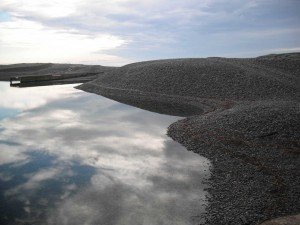
For most of the time the low rainfall in the district means that the volume of water down-river is contained by the low river banks, and some osmosis through the shingle bank at low tide.
When there is heavy rain for protracted periods (which the “locals” think is any more than 3 days) the shallow banks along the stretch of river closest to the coast can’t handle the increased volume, and the surrounding land floods.


Back in the late 1800’s a group of genius’s got together and built the perfect solution to their flooding troubles. “The Box” is a wooden structure which allows for the release of internal pressure within the river and lagoon in times of flood through the creation of an “opening”, made by water from inside pushing the shingle away from the side of “the box”, to the sea.

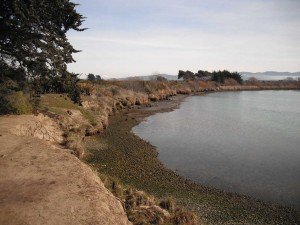
Depending on tidal flows and internal water levels “the box” may remain “open” for a number of days until the waves push the stones back into the opening in sufficient quantity that it again blocks the outflow from the river -which has by now returned to pre-flood levels.
When “the box is open” fish from the sea (like mullet and flounder) can, and do, swim in and adapt to life in the lagoon, and whitebait can make their way up-river. The self-regulating system that allows the release of excess water also maintains a sufficient level in the lagoon and surrounding wetlands to sustain the local fish and fowl populations.
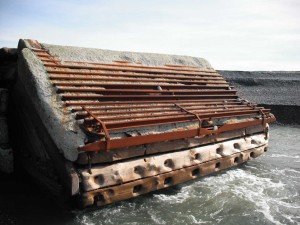
Apart from maintenance of the structure (and there are no moving parts, to wear out or become stuck) there is no human involvement required. No need to struggle against the forces of nature, just patiently wait for things to work themselves out knowing that the situation is only temporary. “And this, too, shall pass…”
It’s a beautiful thing,
Don’t you agree?